
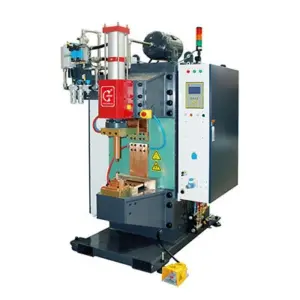
In modern manufacturing, resistance welding technology has become one of the most efficient and reliable methods for joining metal components at scale. A resistance welder is widely used across automotive, aerospace, electrical appliances, battery manufacturing, and heavy engineering industries due to its speed, repeatability, and automation compatibility.
For OEMs, production engineers, and automation integrators, understanding how a resistance welder works and selecting the right configuration can significantly improve production quality, reduce costs, and enhance manufacturing consistency.
What is a Resistance Welder?
A resistance welder is a type of industrial welding equipment that joins metals by applying pressure and passing high electrical current through the contact area. The heat generated at the interface melts or softens the metal, forming a strong metallurgical bond once cooled.
The process follows Joule’s Law (Q = I²Rt), meaning heat is generated based on electrical current, resistance, and time. Because of this precise control, resistance welding is ideal for high-volume production lines where consistency is critical.
Unlike traditional arc welding, resistance welding does not require filler materials, shielding gas, or open flames making it cleaner, faster, and easier to automate.
Working Principle of Resistance Welding
The resistance welding process is based on three core elements:
- Current (I) – High electrical current passes through the metal
- Pressure (Force) – Electrodes clamp the workpieces together
- Time (t) – Current is applied for milliseconds to seconds
When current flows through the resistance at the contact point, intense localized heat is generated. The metal reaches a plastic or molten state, forming a weld nugget that solidifies under pressure.
This process is extremely fast often completed in milliseconds making it ideal for mass production environments such as automotive body assembly lines where thousands of welds are made per unit.
Types of Resistance Welder Systems
Modern manufacturing uses different types of resistance welders depending on application requirements:
1. Spot Welding Machines
The most common type, used for sheet metal joining in automotive and appliance manufacturing. Electrodes clamp two sheets together and form a localized weld point.
2. Projection Welding Machines
Used for pre-formed projections (nuts, bolts, fasteners). Multiple weld points can be created in a single cycle.
3. Seam Welding Machines
Continuous welding process used for leak-proof joints such as fuel tanks or pipes.
4. MFDC Resistance Welders
Mid-frequency direct current systems offer better energy control, reduced heat loss, and improved weld consistency for advanced materials.
5. Capacitor Discharge Welders
These use stored energy released in a short burst, ideal for sensitive or high-strength materials with minimal heat distortion.
Industrial Applications of Resistance Welder
A resistance welder is a backbone technology in modern industrial production.
Automotive Manufacturing
- Car body panels
- Door frames
- Structural reinforcements
Automotive plants may use thousands of spot welds per vehicle body, making automation essential.
Electrical & Electronics Industry
- Battery tab welding (lithium-ion cells)
- Electrical connectors
- Busbars and terminals
Aerospace Industry
- Lightweight aluminum structures
- High-strength alloy assemblies
Heavy Engineering & Appliances
- Metal cabinets
- HVAC systems
- Industrial enclosures
Because resistance welding minimizes distortion and does not require filler materials, it ensures cleaner, more precise manufacturing output.
Advantages of Resistance Welding Technology
A modern resistance welder offers several production benefits:
High Production Speed
Welding cycles often take less than a second, ideal for automated assembly lines.
Excellent Automation Compatibility
Easily integrated into robotic systems and CNC production lines.
Clean and Efficient Process
No fumes, no filler metals, and minimal post-processing required.
Consistent Weld Quality
Controlled current, pressure, and time ensure repeatable results.
Energy Efficiency
Heat is generated only at the weld interface, minimizing energy waste.
Challenges and Considerations
While resistance welding is highly effective, engineers must consider:
- Electrode wear over long production cycles
- Material conductivity differences (aluminum requires higher current)
- Precise process control for weld consistency
- Proper cooling systems for high-duty applications
Selecting the correct machine configuration is critical for achieving optimal performance in production environments.
Why Heron Welder for Resistance Welding Solutions?
As a global manufacturer, Heron Welder specializes in advanced resistance welding systems designed for modern industrial requirements.
Our solutions include:
- MFDC spot welding systems
- Capacitor discharge welding machines
- Projection and seam welders
- Custom automated welding production lines
- Integrated clinching and FSPR riveting systems
Heron systems are engineered for:
- High-volume automotive production
- Precision electronics manufacturing
- Heavy-duty industrial applications
- Smart factory automation integration
With decades of engineering expertise, Heron helps manufacturers achieve higher productivity, stable weld quality, and lower operational costs through customized welding automation solutions.
FAQs About Resistance Welder
1. What materials can a resistance welder join?
It can join steel, stainless steel, aluminum alloys, copper alloys, and various coated metals depending on machine configuration.
2. Is resistance welding stronger than traditional welding?
Yes, in many sheet metal applications, resistance welding provides highly consistent and durable joints, especially in mass production environments.
3. What industries use resistance welding the most?
Automotive, aerospace, electronics, battery manufacturing, and appliance production are the major users.
4. Can resistance welders be automated?
Yes, most modern resistance welders are fully compatible with robotic arms and automated production lines.
5. What is the main limitation of resistance welding?
It is best suited for thin to medium sheet metals and may not be ideal for very thick materials without specialized systems.
Conclusion: The Role of Resistance Welder in Smart Manufacturing
A resistance welder is more than just a joining machine—it is a core enabling technology for high-speed, high-precision industrial manufacturing. From automotive body assembly to advanced electronics, it ensures strong, consistent, and cost-efficient metal joining.
As factories move toward automation and Industry 4.0 standards, resistance welding systems will continue evolving with smarter controls, energy-efficient designs, and integrated production intelligence.
Request a Custom Welding Solution from Heron
If you are looking to improve your production efficiency, automate welding processes, or develop a customized metal-joining solution, Heron Welder can support your needs with advanced engineering expertise and global manufacturing capability.
Contact Heron today to request a quotation or consult our engineering team for a tailored resistance welding solution for your production line.

 English
 Arabic
 French
 Spanish
 Portuguese
 Turkish
 Dutch
Dutch
 Italiano
 Russian
 Romaian
 Portuguese (Brazil)
 Greek
Greek