
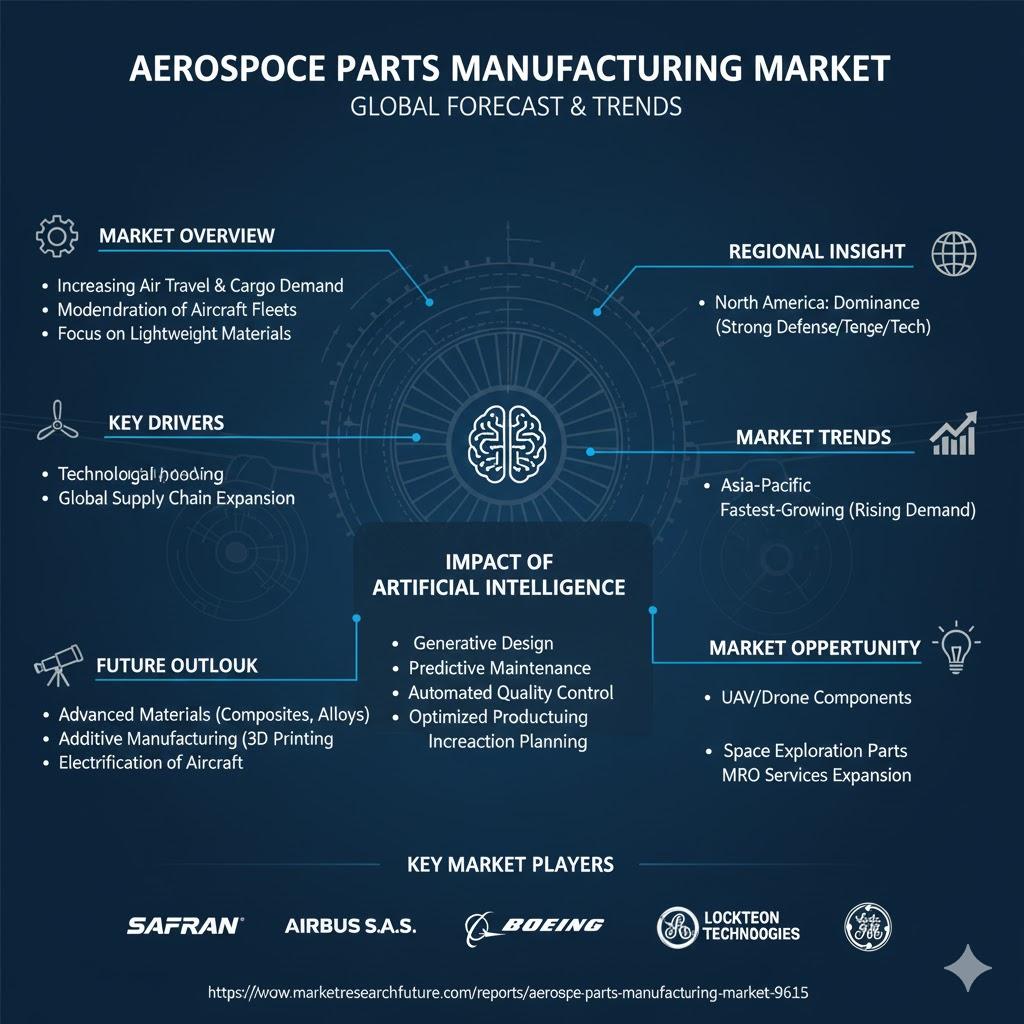
As per Market Research Future analysis, the Aerospace Parts Manufacturing Market Size was estimated at 85.53 USD Billion in 2024. The Aerospace Parts Manufacturing industry is projected to grow from 88.24 USD Billion in 2025 to 120.56 USD Billion by 2035, exhibiting a compound annual growth rate (CAGR) of 3.17% during the forecast period 2025 - 2035.
Introduction
The Aerospace Parts Manufacturing market plays a crucial role in the global aerospace ecosystem, delivering essential components that power commercial, military, and general aviation aircraft. With growing air traffic, technological advancements, and increasing demand for fuel-efficient aircraft, the market is poised for steady growth. Manufacturers are focusing on enhancing precision, reducing production costs, and implementing innovative materials such as composites and advanced alloys.
Market Growth and Trends
The market growth is driven by several key factors:
-
Rising Aircraft Deliveries: The expansion of airline fleets, particularly in Asia-Pacific and North America, fuels demand for aerospace components.
-
Technological Innovations: Adoption of additive manufacturing, automation, and digital twins enhances production efficiency and reduces errors.
-
Defense Spending: Governments are investing in modernizing their defense aircraft fleets, boosting aerospace parts manufacturing.
-
Sustainability: Lightweight components and eco-friendly materials help manufacturers meet stringent environmental regulations.
Current trends include:
-
Increasing use of 3D printing for rapid prototyping and production of complex parts.
-
Greater focus on digital supply chain management to optimize inventory and reduce lead times.
-
Collaborations between OEMs and component suppliers for next-generation aircraft solutions.
Key Players
The aerospace parts manufacturing landscape is dominated by several established players:
-
Honeywell International Inc. – Specializes in avionics, engines, and aerospace components.
-
GE Aviation – Provides high-performance aircraft engines and related parts.
-
Rolls-Royce Holdings – Offers aircraft engines and maintenance support.
-
Safran Group – Focused on propulsion and aerospace equipment manufacturing.
-
United Technologies Corporation – Engaged in innovative aerospace components and systems.
These companies invest heavily in R&D to improve product quality, optimize manufacturing processes, and maintain competitiveness in a highly demanding market.
Future Scope
The future of aerospace parts manufacturing is promising due to continuous innovation and increasing aircraft demand. Key growth opportunities include:
-
Expansion in emerging markets, especially India, China, and Southeast Asia.
-
Integration of AI and IoT for predictive maintenance and quality control.
-
Advancements in lightweight composite materials for fuel-efficient aircraft.
Manufacturers who focus on innovation, sustainability, and operational efficiency are likely to capture significant market share in the coming decade.
FAQ
Q1: What are the major factors driving the aerospace parts manufacturing market?
A1: Rising aircraft deliveries, technological advancements, defense spending, and sustainability initiatives are the primary drivers.
Q2: Which regions are experiencing the highest growth in this market?
A2: Asia-Pacific and North America are witnessing strong growth due to increasing air travel and defense investments.
Q3: Who are the key players in aerospace parts manufacturing?
A3: Honeywell, GE Aviation, Rolls-Royce, Safran Group, and United Technologies are among the leading companies.
Q4: What role does technology play in market growth?
A4: Advanced manufacturing techniques like 3D printing, automation, and digital supply chain management are revolutionizing production efficiency.
Discover More Research Reports on Aerospace & Defense By Market Research Future

 English
 Arabic
 French
 Spanish
 Portuguese
 Deutsch
 Turkish
 Dutch
Dutch
 Italiano
 Romaian
 Portuguese (Brazil)
 Greek
Greek